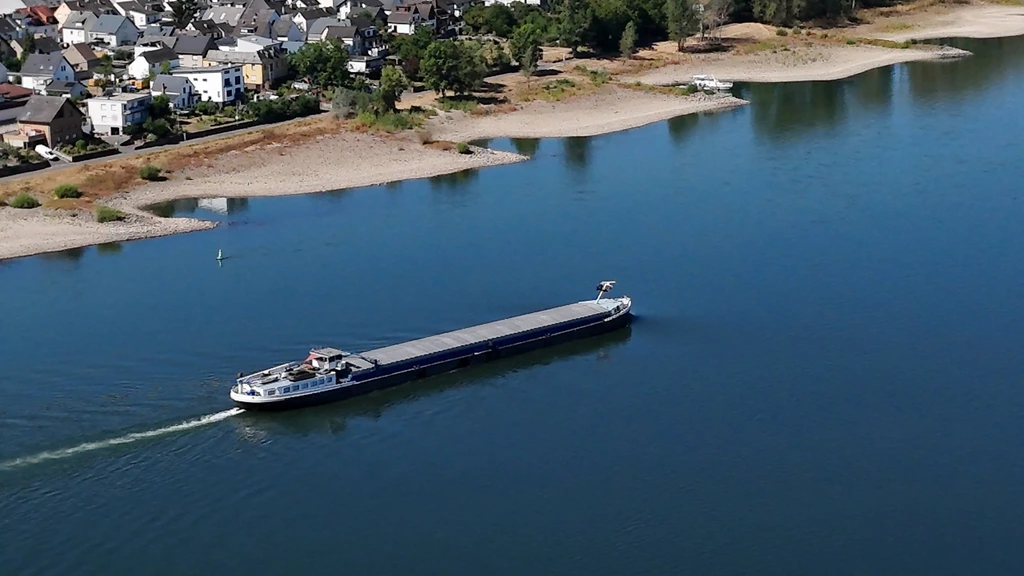
At Duisburg the fairway is down to 1.85 metres and around 1.30 metres at the critical Kaub point, and outside the dredged channel the river is expected to run dry there within days. Almost no cargo vessel can still pass Kaub, de facto splitting the Rhine in two: from the Netherlands ships go no farther than the Ruhr and Cologne, while upstream traffic from Mainz southward and toward the Danube can still move but cannot reach a seaport. The Deutsche Transport-Genossenschaft cooperative reports its roughly one hundred ships are loading at about 20 percent capacity, with hydrochloric acid shippers keeping only 10 to 20 centimetres of clearance and sometimes touching bottom. The ifW research institute expects Germany's already weak economic growth this year to be wiped out, and low-water transport is being shifted partly to road and rail, where a single vessel's load equates to roughly one hundred trucks.
Context
The BDB warning of August 10 that through-navigation risked splitting the river into northern and southern sections has been realised within two days.
